A global economic operating system

Turn economic intent into accountable execution.

Economic Grid connects intelligence, capital and productive capacity through a global network of bounded authority, verified outcomes and accountable commitments.

Founding research project White paper v0.2 · 2 October 2026 · no live network yet
From objective to settlement An objective becomes a mandate. Inside the mandate boundary, agents, productive capacity and capital execute the work. Independent verification checks the evidence, settlement releases payment, and every commitment is recorded on the obligation ledger. Objectiveintent Mandatebounded authority MANDATE BOUNDARY Agent Capacity Capital Agent Verificationindependent evidence Settlementconditional release OBLIGATION LEDGERevery commitment keeps a named holder
05 / 05SettlementObjective, mandate, execution, verification and settlement — with every commitment recorded on the obligation ledger.

01Outcome explorer

What do you want to accomplish?

Choose a scenario and follow it through the grid: objective and constraints, the mandate you would sign, who takes part, how work is checked, how money moves and what survives the project.

Illustrative system demonstration

Launch a subscription app in nine languages

A founder’s limited company in Tartu, Estonia — verified to tier V2

Budget
€60,000
Deadline
6 weeks
Scope
9 languages · 4 legal reviews
Funding
Pre-funded escrow

Objective

Localize a subscription app into nine languages, have consumer law reviewed in four EU markets, and launch with payments and support running within six weeks.

Success means

  • App live in all nine languages
  • Signed consumer-law opinions for four markets
  • Payments and support operating at launch

02Architecture

Twelve components. Six planes. One spine.

The proposed architecture coordinates globally, decides locally and leaves assets and authority with their owners. Select a component to see what it does, what it needs and what depends on it.

Plane 6Institutional

Plane 5Value & accountability

Plane 4Execution & evidence

Plane 3Markets

Plane 2Intent & authority

Plane 1Knowledge

Mandate & obligation spine — crosses every plane

02Intent & authority

Outcome compiler

Proposed component

Turns an outcome request into a mandate graph with priced, insured and verifiable options, proves the non-expansion invariants and produces a plain-language consequence preview.

Inputs

  • Outcome request
  • Graph data
  • Prices and cover quotes

Outputs

  • Execution offers
  • Mandate drafts with invariant proofs
  • Consequence preview

Depends on

Plane 6 Institutional

11Jurisdictional institutions & compliance

Compiles local law into mandate constraints and performs identity, sanctions, tax and consumer checks at the right points, through locally licensed regional operators.

Inputs: National law and licences; Jurisdiction profiles.

Outputs: Legal constraints in every mandate; Tax withholding instructions; Licensed regional operation.

Depends on: 12 Governance, security, observability & emergency controls.

Proposed component
12Governance, security, observability & emergency controls

Sets protocol rules through a foundation, secures keys and agents, monitors the system and contains failures with scoped safe modes.

Inputs: Telemetry; Incident reports; Foundation decisions.

Outputs: Protocol versions; Certifications; Circuit breakers and incident registry.

Depends on: Oversees every other component.

Proposed component

Plane 5 Value & accountability

09Payments, settlement, treasury & capital

Settles conditionally across payment rails, nets obligations, manages liquidity and currency, and hosts the capital farm through licensed partners.

Inputs: Acceptance decisions; Escrow instructions; Capital mandates.

Outputs: Final payments; Holdbacks; Funding for mandates.

Depends on: 08 Evidence & verification · 10 Liability, cover, collateral & disputes · 11 Jurisdictional institutions & compliance.

Proposed component
10Liability, cover, collateral & disputes

Allocates liability per mandate, binds cover, holds collateral, sets accountability margin and runs the dispute ladder.

Inputs: Mandates; Exposure data; Evidence.

Outputs: Bound cover; Margin requirements; Dispute outcomes.

Depends on: 08 Evidence & verification · 09 Payments, settlement, treasury & capital · 11 Jurisdictional institutions & compliance.

Proposed component

Plane 4 Execution & evidence

07Execution

Connects software agents, people, robots and factories through adapters and streams milestone events.

Inputs: Contracts; Execution mandates.

Outputs: Work performed; Milestone events; Evidence signed at source.

Depends on: 03 Identity, authorization & recognition · 06 Assembly of temporary networks.

Proposed component
08Evidence & verification

Collects tamper-evident evidence, routes checks to independent verifiers and decides acceptance or dispute. No performer certifies its own material work.

Inputs: Milestone events; Documents and sensor data; Inspection results.

Outputs: Acceptance decisions; Disputes; Track-record attestations.

Depends on: 03 Identity, authorization & recognition · 04 Agents & capability markets · 07 Execution.

Proposed component

Plane 3 Markets

04Agents & capability markets

Lists synthetic actors, human services and machines with their capabilities, prices, performance records and cover.

Inputs: Certified agent listings; Capacity offers; Track records.

Outputs: Candidate performers for each mandate.

Depends on: 01 Global economic graph · 03 Identity, authorization & recognition · 10 Liability, cover, collateral & disputes · 12 Governance, security, observability & emergency controls.

Proposed component
05Discovery, negotiation, pricing & contracting

Runs requests for quotes, auctions and bilateral negotiation inside mandate bounds, and forms contracts that reference the mandate.

Inputs: Mandates; Candidate performers; Standard terms.

Outputs: Contracts with mandate references; Obligations recorded on the ledger.

Depends on: 02 Outcome compiler · 03 Identity, authorization & recognition · 04 Agents & capability markets · 11 Jurisdictional institutions & compliance.

Proposed component
06Assembly of temporary networks

Composes multi-party bundles, critical paths and redundancy, chooses a legal container, and binds cover and capital before any commitment.

Inputs: Execution offer; Contracts; Cover and capital commitments.

Outputs: Assembled temporary enterprise; Obligation inventory.

Depends on: 05 Discovery, negotiation, pricing & contracting · 09 Payments, settlement, treasury & capital · 10 Liability, cover, collateral & disputes.

Proposed component

Plane 2 Intent & authority

02Outcome compiler

Turns an outcome request into a mandate graph with priced, insured and verifiable options, proves the non-expansion invariants and produces a plain-language consequence preview.

Inputs: Outcome request; Graph data; Prices and cover quotes.

Outputs: Execution offers; Mandate drafts with invariant proofs; Consequence preview.

Depends on: 01 Global economic graph · 05 Discovery, negotiation, pricing & contracting · 10 Liability, cover, collateral & disputes · 11 Jurisdictional institutions & compliance.

Proposed component
03Identity, authorization & recognition

Identifies persons, entities, agents and machines; issues and checks mandate credentials; records which counterparties and jurisdictions accept which credentials.

Inputs: Registry data and electronic IDs; Operator credentials; Signed mandates.

Outputs: Verified identities and tiers; Real-time mandate status; Recognition decisions.

Depends on: 11 Jurisdictional institutions & compliance · 12 Governance, security, observability & emergency controls.

Proposed component

Plane 1 Knowledge

01Global economic graph

Represents participants, capabilities, assets, demand, spare capacity, constraints and track records — with provenance for every claim.

Inputs: Public registers and filings; Participant submissions; Verified attestations; Completed-obligation records.

Outputs: Discoverable capabilities and constraints; Eligibility data for mandates.

Depends on: 03 Identity, authorization & recognition · 08 Evidence & verification.

Proposed component

Mandate & obligation spine — crosses every plane

How the grid separates public, verified and authorized information →

03Mandates

Sign bounds, not steps.

The accountable mandate is the grid’s fundamental unit. It keeps three things apart that software usually blurs: what you want, what you authorize and what you become committed to.

  1. What you want

    An outcome request

    A result, a budget, a deadline and the constraints that matter. It binds no one.

  2. What you authorize

    A mandate

    Bounded, signed and revocable authority. You sign bounds, not steps — every agent and counterparty is held to them.

  3. What you become committed to

    Obligations

    Contracts formed inside the mandate with named counterparties, recorded on the ledger with evidence rules and a holder.

EG-MND-DEMO-0001 Example mandate
Principal
A founder’s limited company, verified to tier V2
Outcome
Launch the app in nine languages, with consumer-law review in four EU markets
Budget
€60,000 held in escrow · no counterparty above €5,000 without approval
Scope
Buy localization, legal review, payment set-up and support · counterparties V2+ · data stays in the EEA
Expiry
42 days after signature · 90-day warranties survive by design
Delegation
Maximum depth 2 · sub-mandates can tighten limits, never relax them · budgets lock when delegated
Verification
A different model family checks every translation · 5% human sample · signed legal opinions
Liability & cover
10% holdback per performer · professional cover required · the principal answers for decisions within scope
Revocation
Stops new commitments at once · contracts already formed unwind on their own terms
Budget conservation in delegation A root mandate of 60,000 euros delegates 36,000 to localization, 12,000 to legal review, 8,000 to payments and support, and keeps 4,000 in reserve. The children add up to the parent. Root mandate €60,000 · 42 days Localization €36,000 Legal review €12,000 Payments& support €8,000 Reserve €4,000 Children never exceed the parent: 36 + 12 + 8 + 4 = 60 Limits can tighten down the tree, never relax
Delegation without expansion: budgets lock when a sub-mandate is created, so authority, spending and liability cannot grow as work is divided.

The full structure, the chain from objective to settlement, and the six invariants →

04Economic farms

Your own domain inside the wider grid.

An economic farm is the set of activities and assets that one owner — a person, a family business, a cooperative, a company — controls within the network. The capital farm is its financial subsystem.

Inside its boundary, the owner coordinates its own agents, capital and productive capabilities under its own mandates. Across the boundary, it reaches counterparties, verifiers, capital and cover — always through a mandate, never by default.

  • Publish spare capacity in machine-readable form
  • Run agents under bounded, revocable authority
  • Keep money in segregated, purpose-bound accounts
  • Form temporary enterprises that close cleanly

How economic farms work →

An economic farm inside the wider grid Inside a bounded frame, an owner grants mandates to its own agents, its capital farm and its productive capacity; contracts become obligations. Through the boundary, the farm connects to counterparties, verifiers, capital organisms and insurers in the wider grid. ECONOMIC FARM Owner legal person Mandates Agents Capital farm Capacity Obligations THE WIDER GRID Counterpartiesbuyers, suppliers Verifiersindependent checks Capital organismslicensed managers Insurers & mutualscover, collateral
Gates on the boundary mark where authority crosses into the wider grid — always through a mandate, never by default.

05Accountability

Accountability

A credential is not personhood. An authorized action is not a contract.

Synthetic actors can be economically autonomous inside a mandate. Legal responsibility stays with people and institutions. The grid is built around that separation.

  1. 01

    Verification

    Evidence is checked by someone other than the performer. Material work is never self-certified; checks use a different model family or a human.

  2. 02

    Risk limits

    Budgets lock when work is delegated, open obligations are margined against cover, and no single model family may carry a whole critical path.

  3. 03

    Named responsibility

    Every commitment traces to a legal person who answers for it — a principal, a performer, a liability anchor. Agents act; people and institutions answer.

  4. 04

    Surviving obligations

    Warranties, records, taxes, maintenance and claims outlive the project. An enterprise may close only when each has a funded holder.

Revocation stops new authority; it never erases valid commitments.

Dissolution transfers obligations; it never erases them.

06Research

The founding white paper.

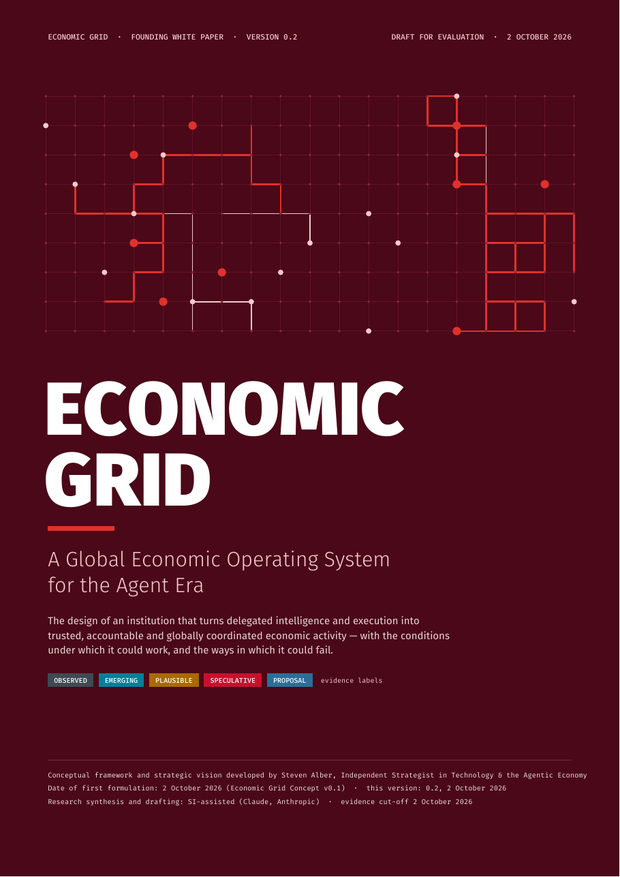
Cover of Economic Grid — A Global Economic Operating System for the Agent Era, version 0.2

White paper · version 0.2

Economic Grid — A Global Economic Operating System for the Agent Era

Version
0.2 · draft for evaluation
Date
2 October 2026
Length
74 pages · 19 sections · 8 diagrams
Format
PDF · 0.4 MB

The founding design: the mature system first, then what would have to become true for it to work. It defines the accountable mandate, a twelve-component architecture, temporary enterprises with persistent obligations, a capital system, liability institutions, governance and illustrative economics — and states plainly where the design could fail.

Every consequential claim carries an evidence label: observed, emerging, plausible, speculative — or proposal, for design choices. Appendix A records which earlier claims were rechecked and which were not.
07Participation

Join the founding phase.

Economic Grid is at the research and design stage. Registering interest helps decide which corridors, partners and questions come first. Nothing here is a live service or an offer of financial products.

Businesses

Tell us what you need done, or which capacity you could publish — spare machine time, services, logistics. Founding participants shape the first corridors.

Register interest as businesse →

Developers

Build agents, verifiers or integrations against the mandate and obligation model as the protocol specification takes shape.

Register interest as developer →

Researchers

Challenge the white paper. The research agenda lists fourteen open questions — legal, technical and economic — that need independent work.

Register interest as researcher →

Capital partners

Licensed lenders, insurers and fund managers who could underwrite verified obligations as the capital system matures.

Register interest as capital partner →

Infrastructure providers

Payment, identity, inspection, logistics and compliance providers who could operate regulated functions under local law.

Register interest as infrastructure provider →