Research

Economic Grid White Paper v0.2

The founding design of a global economic operating system for the agent era — written mature system first, with the conditions under which it could work and the ways it could fail stated as plainly as the design itself.

Published 2 October 2026 Draft for evaluation

The white paper

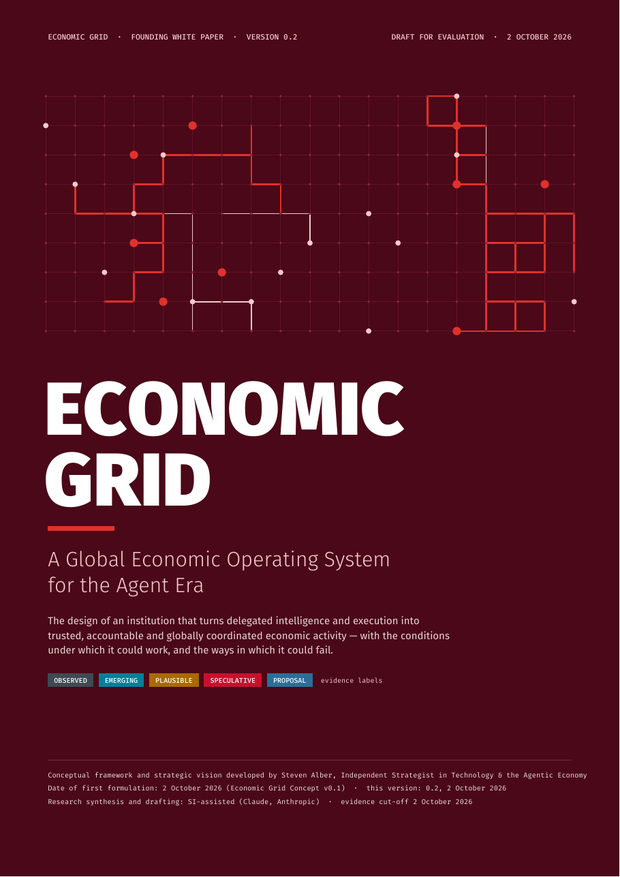
Cover of Economic Grid — A Global Economic Operating System for the Agent Era, version 0.2

White paper · version 0.2

Economic Grid — A Global Economic Operating System for the Agent Era

Version
0.2 · draft for evaluation
Date
2 October 2026
Length
74 pages · 19 sections · 8 diagrams
Format
PDF · 0.4 MB

The founding design: the mature system first, then what would have to become true for it to work. It defines the accountable mandate, a twelve-component architecture, temporary enterprises with persistent obligations, a capital system, liability institutions, governance and illustrative economics — and states plainly where the design could fail.

Every consequential claim carries an evidence label: observed, emerging, plausible, speculative — or proposal, for design choices. Appendix A records which earlier claims were rechecked and which were not.

01Key findings

Six ideas that carry the design.

The scarce thing is standing.

When intelligence and execution are abundant, what remains scarce is the ability to commit resources, bind counterparties and answer for outcomes.

Reliability sets the price; institutions set the supply.

Reliability binds how long agents can act unsupervised. Accountability binds how many commitments can be made credible at once.

Commitments must not outrun accountability.

Open obligations are margined against cover, the way a clearing house margins positions.

Open rules, scarce services.

The recommended architecture is an open protocol under a foundation, a commercially strong founding operator, and licensed regional operators.

“Hundreds of billions” has six meanings.

Transaction volume, enterprise value or assets under management could reach that scale at high adoption. Platform revenue could not.

The deepest tension is named.

Concentration in the accountability layer is a natural tendency that governance can slow but not abolish.

02Illustrative economics

Sobering by design.

The paper models four adoption levels on stated assumptions. The first two lose money while accountability institutions are built. The take rate decides everything: priced as coordination, fees fall towards the cost of compute; priced as accountability, they can hold.

Model outputs, not forecasts

Illustrative adoption levels from the white paper model
LevelTransaction valueRevenueOperating result
L1 Foothold$5.3 bn$69 m−$142 m
L2 Regional$72 bn$806 m−$225 m
L3 Global$900 bn$8.2 bn+$1.9 bn
L4 Operating system$6.0 tn$42.2 bn+$17.0 bn

03Contents

Nineteen sections.

  1. Executive thesis
  2. Founding purpose and user capability
  3. First-principles economic mechanism
  4. Complete architecture
  5. The accountable mandate
  6. Temporary enterprises and persistent obligations
  7. Agents, trust and verification
  8. Capital and settlement
  9. Liability and institutional design
  10. Governance, openness and power
  11. Global participation and network effects
  12. Business model and illustrative economics
  13. Competitive strategy
  14. Systemic risk and failure containment
  15. Counterarguments
  16. Scenario-dependent evolution
  17. Original contributions
  18. Critical unknowns and research agenda
  19. Final founding thesis

Plus a preface on what was retained, changed and rejected from the two source documents, a glossary, Appendix A on corrections and source rechecks, and a source list.

04Original contributions

Six proposals.

  1. Mandate algebra and a mandate compiler
  2. Accountability margining and obligation clearing
  3. A dissolution gate, estate holders and a market for residual obligations
  4. Obligation-bound portable trust
  5. A correlation charge and model-diversity requirements
  6. Sovereign scope directives

Each is assessed against its precedents. Most combine established mechanisms in a new setting; the paper says which elements it considers new, and notes that a systematic prior-art search is still to be done.

05Evidence discipline

Every claim carries a label.

LabelMeaning
ObservedDocumented facts, laws in force, published data
EmergingDevelopments under way, with early evidence
PlausibleReasoned extrapolation from current trends
SpeculativePossible configurations with limited evidence
ProposalA design choice of the paper — not a claim about the world

Appendix A separates the claims from earlier work that were rechecked for this paper from those that were not, and no source is described as verified unless it was actually checked.

Terminology. The paper writes “SI” where most sources write “AI”. It names a field and its systems, not a claim that any system is superintelligent.

Background. Version 0.2 builds on the Estonian-language Economic Grid Concept v0.1 and on an earlier, unpublished strategic study.

Challenge the paper as a researcher